Eye Movements, Reading, and the Contested Neuroscience of Dyslexia's Visual Dimension

For the better part of four decades, the dominant scientific framework for understanding dyslexia has been phonological: the disorder, on this account, is fundamentally one of phonemic awareness and phonological processing, rooted in left-hemisphere language networks and only incidentally connected to vision. That framework has generated substantial clinical and educational progress. It has also, some researchers now argue, foreclosed inquiry into visual and oculomotor factors that may play a meaningful, if secondary, role in reading difficulty for a subset of affected individuals.
The tension between these perspectives is not merely academic. It has direct implications for how clinicians assess struggling readers, how educators design interventions, and how the broader research community allocates investigative resources. In recent years, advances in eye-tracking technology, high-resolution neuroimaging, and quantitative oculomotor assessment have produced a literature that is simultaneously more rigorous and more contested than what preceded it.
The Oculomotor Profile of Dyslexic Readers
Eye movement research in reading is technically demanding but methodologically well established. Studies using high-speed eye-tracking equipment have consistently documented differences between skilled and dyslexic readers in several key parameters: fixation duration (how long the eyes pause on a word or word segment), saccadic amplitude (the size of the forward jumps between fixations), and the frequency of regressive saccades (backward eye movements that revisit previously scanned text).
Dyslexic readers, as a group, show longer fixation durations, shorter forward saccades, and substantially more regressions than age-matched controls. The question that has animated considerable scientific debate is whether these differences constitute evidence of a primary oculomotor deficit or are simply the behavioral signature of labored decoding—that is, whether the eyes move differently because the visual system is impaired, or because slow phonological processing keeps the eyes anchored to text the brain cannot yet decode.
The phonological camp has long argued for the latter interpretation, and the evidence supporting it is substantial. When reading tasks are controlled for linguistic complexity, many of the eye movement differences between dyslexic and typical readers diminish or disappear. This finding has been interpreted as confirmation that aberrant eye movements are a downstream consequence of the core phonological deficit, not an independent contributing factor.
However, a different set of findings complicates that tidy account.
Vergence Dysfunction and the Near-Vision Hypothesis
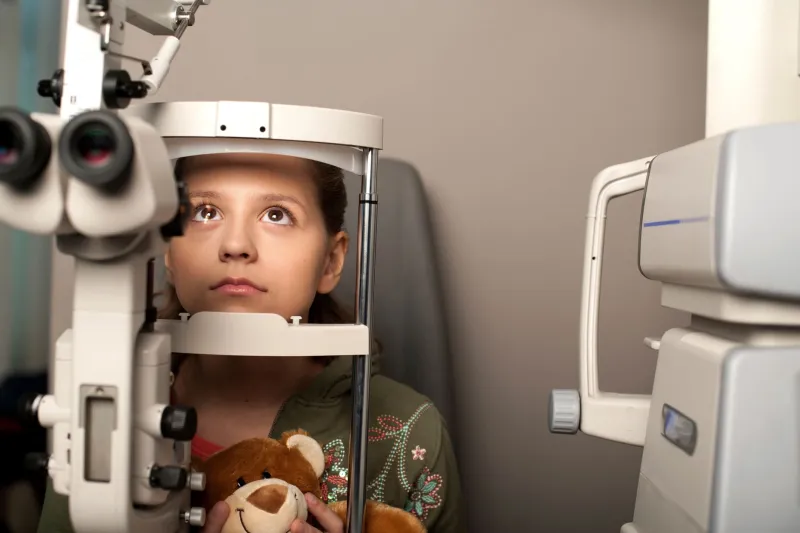
Convergence insufficiency—a condition in which the eyes fail to maintain comfortable, accurate alignment during near-point tasks—has emerged as a particular focus of optometric research in the context of reading disorders. Unlike gross oculomotor differences that may reflect cognitive load, vergence dysfunction represents a measurable physiological impairment in binocular coordination that is, in principle, independent of phonological processing capacity.
Several studies have documented elevated rates of convergence insufficiency and other binocular vision anomalies in populations of children with reading difficulties. Research published in Optometry and Vision Science and the Journal of the American Optometric Association has reported that children referred for reading difficulties show significantly higher rates of vergence dysfunction than matched controls without reading complaints. These findings have been replicated across multiple clinical samples, though methodological heterogeneity—differences in how reading difficulty is defined, how vergence dysfunction is measured, and how confounding variables are controlled—limits the strength of conclusions that can be drawn from any individual study.
The mechanistic hypothesis underlying this line of research is straightforward: if the two eyes cannot maintain stable, accurate convergence during near-point reading tasks, the brain receives degraded, inconsistent binocular input. This instability may manifest as visual discomfort, difficulty tracking lines of text, or transient diplopia—all of which could impair reading fluency and comprehension independently of phonological processing skill. On this account, vergence dysfunction would not explain dyslexia in the phonological sense, but it could constitute a comorbid condition that compounds reading difficulty and that, if identified and treated, might improve functional reading performance.
Neuroimaging Evidence and Its Limits
The advent of functional magnetic resonance imaging and diffusion tensor imaging has introduced new tools for examining the neural substrates of both reading and visual processing in dyslexic individuals. Several research groups have reported differences in the activation and structural connectivity of visual cortical areas—including the magnocellular pathway, which is specialized for processing motion and temporal information—in dyslexic compared to typical readers.
The magnocellular deficit hypothesis, developed most prominently by John Stein at Oxford and subsequently examined by researchers across the United States and Europe, proposes that dyslexia in some individuals involves impaired function of the magnocellular layers of the lateral geniculate nucleus, producing instability in visual representations of text. Neuroimaging studies have offered partial support for this hypothesis, documenting reduced activation in dorsal visual stream areas and differences in white matter organization in relevant pathways in some dyslexic samples.
Critiques of this line of work are serious and should not be minimized. Effect sizes in magnocellular research have often been modest. Replication has been inconsistent. And the hypothesis has, at times, been invoked to support commercial visual interventions—colored overlays, tinted lenses, and proprietary tracking programs—that have not demonstrated efficacy in rigorous randomized controlled trials. The scientific community's skepticism toward these applications is warranted and reflects a necessary distinction between evidence-based hypothesis generation and premature clinical translation.
Separating Signal from Noise in the Clinical Literature
The challenge for researchers and clinicians working at the intersection of vision science and reading disorders is to extract meaningful signal from a literature that includes both genuinely important findings and a substantial body of overclaimed, poorly controlled research. Several principles help navigate this terrain.
First, the presence of oculomotor differences in dyslexic readers is not, by itself, evidence that those differences cause reading difficulty. Causality requires longitudinal data, ideally from prospective studies that assess visual function before reading instruction begins and track outcomes over time. Such studies are methodologically demanding but essential.
Second, heterogeneity within the dyslexic population must be taken seriously. Dyslexia is not a unitary condition, and it is plausible—indeed, likely—that visual and oculomotor factors play different roles across different subtypes. Research that treats dyslexia as a homogeneous category will inevitably produce inconsistent findings.
Third, intervention research must meet the same evidentiary standards applied elsewhere in clinical science. The Convergence Insufficiency Treatment Trial established a template for rigorous evaluation of vision-based interventions. Applying that template to proposed treatments for reading-related visual dysfunction is both feasible and necessary.
The Productive Path Forward
The most scientifically productive framing of the dyslexia-vision question may be neither the strong phonological dismissal of visual factors nor the overclaiming of optometric advocates, but rather a genuinely pluralistic model that treats reading as a complex behavior dependent on the integrated function of multiple neural systems—phonological, orthographic, attentional, and oculomotor—and that takes seriously the possibility that dysfunction in any of these systems can impair reading, sometimes independently and sometimes in combination.
Advances in multimodal imaging, computational modeling of eye movement dynamics, and large-scale longitudinal cohort studies now make it possible to test this model with greater precision than was previously available. Research programs that combine high-resolution oculomotor assessment with neuroimaging and behavioral measures of phonological processing are already producing findings that complicate simple single-factor accounts of reading difficulty.
For the field to move forward, the territorial disputes between optometry, neuroscience, and education research must yield to the evidence. Children who struggle to read deserve assessments that are comprehensive, interventions that are validated, and a scientific community willing to follow the data wherever it leads.