Depth Perception in Conflict: How Immersive Display Technologies Are Stress-Testing the Visual Brain
A Problem Built Into the Technology
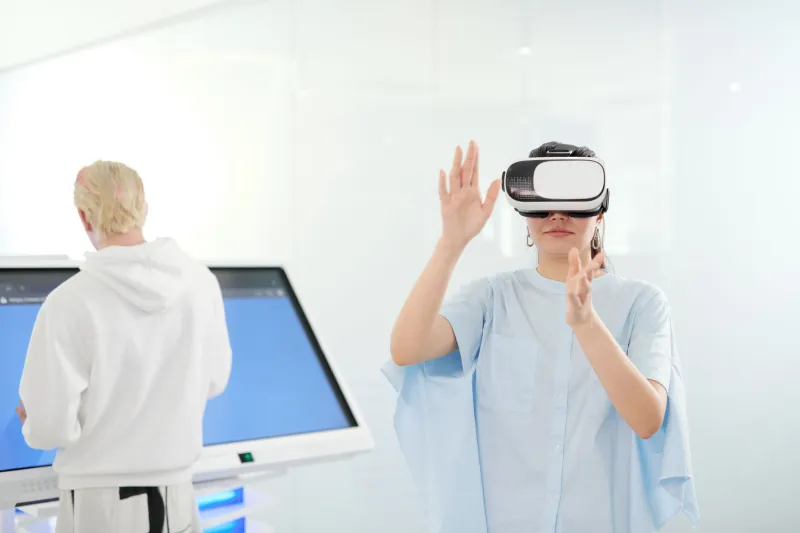
Every time a person dons a virtual reality headset, the visual system is asked to perform something it was never evolutionarily equipped to do. In the natural world, two core oculomotor functions operate in seamless coordination: vergence, the inward rotation of both eyes to converge on a nearby object, and accommodation, the ciliary muscle-driven adjustment of the crystalline lens that brings that same object into sharp focus. These two processes are neurologically coupled — when vergence changes, accommodation follows, and vice versa. For hundreds of millions of years of primate evolution, this linkage was reliable because the physical distance of an object and its optical distance were always identical.
Virtual reality dissolves that equivalence. In a typical head-mounted display, the screen sits roughly 50 to 75 millimeters from the user's eyes, meaning the lens must accommodate to that fixed optical distance regardless of what the rendered scene depicts. Yet the stereoscopic imagery instructs the vergence system to rotate the eyes as though objects exist at varying depths — sometimes simulating distances of several meters or more. The result is what researchers call the vergence-accommodation conflict (VAC), a persistent physiological contradiction that the brain cannot fully resolve.
What the Research Tells Us About Fatigue and Strain
The subjective consequences of VAC have been reported by users since the earliest commercial headsets reached consumers, catalogued under the umbrella term "cybersickness" or, more specifically, visually induced motion sickness. But the underlying mechanisms are considerably more nuanced than nausea alone. Studies published over the past decade have documented a range of measurable physiological responses, including slowed accommodative response times, reduced vergence accuracy, increased blink rate variability, and elevated measures of subjective visual fatigue on validated clinical instruments.
Research conducted at institutions including UC Berkeley's Vision Science program and the Human Interface Technology Laboratory has used wavefront aberrometry and eye-tracking to quantify how accommodative-vergence coupling degrades over sessions of VR exposure. Subjects who completed 20-minute immersive tasks showed statistically significant reductions in phoria recovery — the eye's ability to return to a comfortable resting alignment after sustained convergence demand — compared to control groups performing equivalent tasks on conventional flat displays. These effects were transient in most adult participants, typically resolving within 30 to 90 minutes of headset removal, but the consistency of their appearance underscores that VAC is not merely an anecdotal complaint.
More recent work has begun examining whether the magnitude of the conflict itself — determined largely by how far rendered virtual objects deviate in simulated depth from the fixed screen plane — predicts symptom severity. The emerging consensus suggests a nonlinear relationship: moderate depth disparities produce disproportionately greater strain than small ones, with a threshold effect that varies considerably across individuals based on baseline accommodative flexibility and vergence range.
The Developing Visual System: An Understudied Population
While adult visual systems show measurable but largely reversible responses to VAC, the implications for pediatric users remain substantially less understood and considerably more concerning to researchers. The visual system is not fully mature at birth; accommodation and vergence coupling consolidates throughout childhood and early adolescence, shaped by the statistical regularities of natural visual experience. Introducing a systematic violation of those regularities during sensitive developmental windows raises questions that current longitudinal data are not yet sufficient to answer definitively.
Animal model research has long established that abnormal visual experience during critical periods can produce lasting changes in refractive development — the mechanism underlying form-deprivation myopia and lens-induced refractive shifts. Whether the artificial dissociation of vergence and accommodation cues in immersive displays could influence refractive trajectory in human children is a question that several prospective studies are now actively investigating. The American Academy of Ophthalmology has noted the absence of long-term safety data as a basis for cautionary guidance, recommending against extended VR use in children under 13, though the evidential foundation for any specific age threshold remains thin.
Neuroimaging work adds another dimension. Functional MRI studies examining cortical responses to conflicting depth cues have identified activation in areas including the anterior cingulate cortex — a region associated with conflict monitoring — during VAC conditions, suggesting that the brain does not simply ignore the mismatch but actively expends cognitive resources attempting to reconcile it. For developing brains with less consolidated visual cortical architecture, the implications of that sustained conflict processing are poorly characterized.
Engineering Responses and Their Limitations
The display industry has not been passive in confronting VAC. Several engineering approaches have been proposed or prototyped, including varifocal displays that physically shift the screen's focal plane to match rendered depth, light field displays that reproduce the full plenoptic properties of natural scenes, and computational methods that blur objects at non-fixation depths to simulate natural defocus. Each approach carries trade-offs in hardware complexity, resolution, latency, and cost that have prevented widespread commercial adoption.
Microsoft's research division and academic collaborators have published promising results with gaze-contingent varifocal prototypes that track the user's fixation point in real time and mechanically adjust the display optics accordingly, substantially reducing measured accommodative error. However, the latency requirements for seamless varifocal adjustment — estimated at below 10 milliseconds to avoid perceptible lag — remain at the edge of current actuator and tracking capabilities. Meta's Reality Labs has similarly invested in research-grade prototypes, with published results demonstrating measurable reductions in VAC-related symptoms, though commercial timelines remain unspecified.
Toward a Vision Science Framework for Immersive Media
What the current body of research collectively argues for is a more rigorous application of vision science principles to the design, evaluation, and regulatory consideration of immersive display technologies. Consumer adoption of VR and AR headsets in the United States has accelerated markedly, with market analyses projecting tens of millions of active users within the next several years. The clinical and research communities have not yet established standardized protocols for assessing VAC-related visual risk, nor are there agreed-upon exposure guidelines analogous to those that exist for other visual ergonomic contexts.
Researchers in this space have begun advocating for collaborative frameworks that bring together optometrists, vision scientists, display engineers, and cognitive neuroscientists to develop both better measurement tools and more physiologically informed design standards. The vergence-accommodation conflict is, at its core, a vision science problem wearing a consumer electronics disguise. Addressing it rigorously will require the field to bring its full methodological toolkit — from psychophysics and ocular motor measurement to developmental biology and neuroimaging — to bear on a technology that is already in millions of American living rooms, and in the hands of millions of American children.